
Nobody buys a travel trailer because they love climbing a ladder with a caulk gun on a Saturday morning. You buy a rig for the campgrounds, the road trips, and getting away from the daily grind. But if you’ve owned your camper for more than a couple of seasons, you already know the harsh reality. The roof takes a massive beating. Day in and day out, it bakes in UV rays, freezes in the winter, and gets pelted by rain and tree branches.
Every RV owner dreads that moment. You walk into your trailer, look up, and spot a faint brown water stain on the ceiling panel. By the time that stain shows up inside, water has likely been quietly wrecking your insulation and wood framework for weeks. When water gets in, it’s a nightmare. People usually panic and start looking into a professional rv roof repair at a dealership. Then they get the quote for a full roof replacement, and their jaw drops. It is ridiculously expensive.
So, what’s the alternative? You do it yourself. You look for a coating to seal everything up and buy yourself some time. But this is exactly where so many folks make a massive, exhausting mistake.
The Big Box Store Trap
When faced with a leaking or aging roof, the knee-jerk reaction is to drive to the local hardware store and grab whatever bucket says “liquid rubber” or “elastomeric.” Maybe you buy a standard acrylic. The label makes it sound easy. It’s usually not.
Here is the frustrating reality about traditional coatings: they generally last only about 4 to 5 years. Think about the labor involved. You spend your entire weekend scrubbing the roof, rolling on an expensive primer, waiting for it to dry, and then applying multiple top coats. You’re watching the weather app like a hawk, praying it doesn’t rain and ruin the whole job. And after all that back – breaking work, you’re going to have to do the same thing a few years down the road because the product couldn’t handle the weather. We keep doing this cycle of patching and painting because we think it’s the only option. It isn’t.
Why RV Roof Magic Actually Makes Sense
If you are tired of the four-year maintenance loop, you need to look at products formulated specifically for the abuse an RV takes. RV Roof Magic isn’t just generic hardware-store paint. It’s heavily engineered for travel trailers, motorhomes, houseboats, and even shipping containers.
It has a 25- to 30-year track record in the industry, which means it isn’t some fly-by-night brand that popped up yesterday. Thousands of people have used it to essentially get a brand new roof without paying dealership replacement prices.
What actually separates it from the cheap stuff? The chemistry. RV Roof Magic uses a unique chemical drying process that traditional coatings don’t have. Because of the way it cures, it actually extends the life of your roof by an incredible 18 to 20 years. That isn’t a typo. You are trading a 4-year temporary fix for a two-decade solution. When you map out the time and money saved over your camper’s lifespan, choosing the right rv roof coating is a no-brainer.
Ditching the Primer
Let’s talk about the actual application, because this is where the real relief comes in. RV Roof Magic is a true, genuine one-coat system.
It is currently the only coating in the RV industry that offers a 20-year warranty, goes on in a single coat, and NEVER requires a primer. That alone saves you an entire day of labor and the extra cost of primer buckets.
You also don’t have to play guessing games about what your roof is made of. It is incredibly versatile. You can apply it directly over EPDM, fiberglass, weathered aluminum, metal, aged vinyl, Hypalon rubber, Alpha rubber (like you’d find on Fleetwood RVs), and butyl rubber. Have a TPO roof? It goes over that, too, though you’ll only need a TPO primer if the scrim backing is physically showing through.
A lot of folks ask what happens if they have already tried a different coating a few years ago. As long as you didn’t use silicone, you are fine. RV Roof Magic applies beautifully over previously coated roofs treated with non-silicone products like Dicor, Kool Seal, Henry, Flex Seal, acrylics, and elastomers. The only hard rules are no PVC roofs and no silicone. If you put it over silicone, it stays tacky and won’t cure properly. As long as you clear those two hurdles, the process is incredibly fast. Apply today, drive away tomorrow.
Standing Water and Extreme Weather
Flat and sloped travel trailer roofs have a notorious enemy: ponding water. After a storm, water sits up there in puddles. Standard acrylics and cheap coatings hate standing water. They soften up, break down, and eventually peel right off.
RV Roof Magic is specifically built to withstand ponding water 365 days a year. It doesn’t break down when submerged. Period.
It also handles the massive temperature swings of RV life. Whether your rig is buried in snow during a winter freeze or baking in a 100-degree summer desert, the coating expands and contracts with your vehicle. It meets strict ASTM certifications, meaning the mechanical strength and quality of the materials have been rigorously tested to ensure they hold up on a moving, bouncing vehicle.
Doing the Job Right the First Time
If you are going to take on this project, prep is everything. Don’t cut corners before you open the can.
Start by washing the roof thoroughly. Using Roof Protect Cleaner is your best bet here because it’s specifically formulated to strip away the years of dirt, grease, and chalking that build up on camper roofs. You want a bone-dry, spotless surface before you coat.
Next, walk the roof and check your seams, vents, and skylights. These are the weak points where water always tries to sneak in. If the areas around your AC unit or the front and rear caps look worn, use Butyl MS Caulk, Seam Tape, or Seam Tight to reinforce those joints. If you have an older rig, your skylights might be looking yellowed and chalky. You can brush on some Skylight 911, which is a clear coat that protects the plastic while still letting the sun into your cabin.
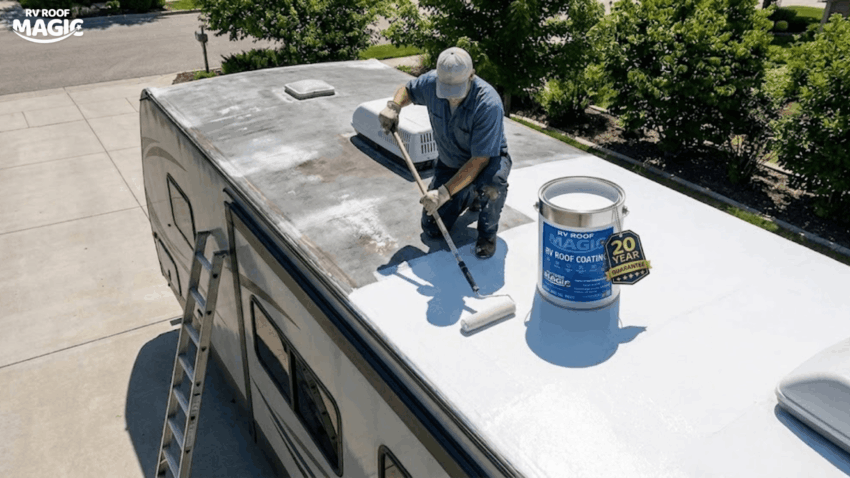
Once your prep is done, grab a heavy-duty Gallon Mixer, mix the product thoroughly, and roll it out. It is self-leveling, which means as it settles, it acts as a heavy-duty RV roof sealant, sinking into all the micro-cracks and pinholes you can’t even see with the naked eye. It dries into a seamless, protective membrane.
Replacing an rv roof is a financial nightmare. Don’t let a weathered factory roof force you into spending thousands at a dealership. By putting in a few hours of work with a proven, single – coat system, you can lock out the weather for the next twenty years and actually get back to doing what you bought the trailer for – enjoying the trip.