4.0
After resealing the EPDM RV roof with RV Roof Magic. WOW!
By Cheri Sicard
My New Year’s resolution was to reseal the EPDM (ethylene propylene diene monomer rubber) roof of my 20-year-old travel trailer. I had watched some online videos, determined this wasn’t brain surgery, and decided that I could do the work myself.
Here’s another challenge I will put out to you if you think you could not undertake this project yourself. If I could do it, you could do it! I am a 60-something-year-old woman with no prior experience who did this job alone.
That’s not to say that a helper or another pair of hands wouldn’t have made the job easier—it definitely would have. Nonetheless, I did all the work with no help whatsoever.
If your physical condition allows you to get up and down your RV’s roof ladder easily and your balance is such that you feel stable while standing on the roof, you can do this RV DIY project, too.
A 20-year-old travel trailer roof, before cleaning
The vents and other roof intrusion points on my RV over the years had been resealed. However, no prior owner had ever undertaken the project of recoating the RV roof. And, boy, did my RV roof need it!
I wish I had gotten more and better photos and/or videos. But that was a tradeoff for not having help. However, I think you’ll get the idea.
This job requires four steps, outlined below. I’ve also included a few tips and tricks I learned while doing it.
Resealing an EPDM roof
Step 1: Assessment and research
Assessing an EPDM roof by looking under the RV bedroom vent.
The first step is to determine what kind of roof your RV has. I was pretty sure I had an EPDM roof. But since I did not have an owner’s manual that came with the used RV when I bought it a few years ago, my fellow RVtravel.com writer and repair guru Dave Solberg walked me through the process of making sure.
All I had to do was remove the vent cover in my trailer’s bedroom. That afforded me a view of the roof’s material, as part of the edges of the material are visible under the vent cover (see photo above).
Sure enough, the material was black on one side and white on the other. Coupled with how the white part of my roof started to powder away after 20 years of use, we determined it was an EPDM roof.
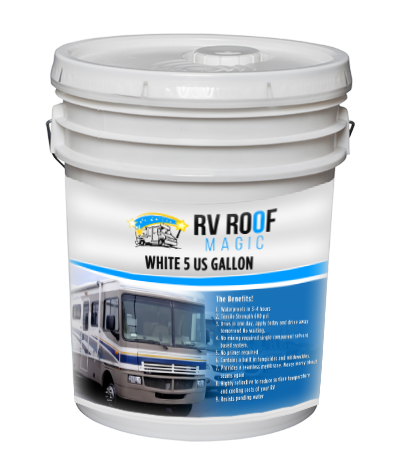
Perfect! Dave then put me in touch with an acquaintance of his, Greg, at RV Roof Magic. I had already been doing roof coating research, but when I looked intoit I was impressed that this liquid butyl rubber product needed no primer before applying. I also LOVED the fact that it comes with a 10-year warranty.
A one-time application that stops leaks and protects the RV roof for ten years? As I doubt I will keep this RV anywhere near that long, that sounded great to me. I will never have to recoat this RV’s roof again. RV Roof Magic, it is!
Step 2: Procurement
I talked to Greg, who determined I would need about 4 gallons of RV Roof Magic for my 25-foot travel trailer. (I actually used just a little over 3 to complete the job.) He also suggested I use RV Roof Magic’s proprietary cleaner to clean and prep the roof’s surface before recoating it.
This eco-friendly, biodegradable cleaner is designed to complement RV Roof Magic roof coating. It emulsifies contaminants and provides improved surface preparation and adhesion by effectively removing oil, grease, mildew, dirt, and other soils from the roofing membrane. And believe me, my roof had ALL of those and lots of them. It also contains a mildewcide to kill any mold spores on your roof before an RV roof sealing application.
This close-up shows the dirt and mildew on my roof before cleaning.
In addition to the RV Roof Magic EPDM roof coating and cleaner, I also made sure to get all the other supplies I would need to complete the job:
Tarp to cover the on-the-ground work area
Work gloves
Handheld brush for cleaning
Hose nozzle for rinsing
Medium 3/8-inch nap paint rollers and roller handle
A couple of acrylic paintbrushes
Bucket(s)
Paint roller tray
Paint stirrer attachment for my drill
Screwdriver to pry open the RV Roof Magic can
Caulk gun and sealant (I had some Pro Flex® RV sealant on hand)
Step 3: Cleaning and prep
Dirty EPDM roof before cleaning
I will be honest, this step was the biggest pain-in-the-rear of the project. In comparison, the rest is easy. Cleaning, on the other hand, is a lot of physical labor.
In addition to 20 years of dirt and wear, I had recently parked under a palm tree that deposited sticky black seeds or berries all over the roof (see photo above). I began by sweeping before scrubbing.
I scrubbed every inch, nook, and cranny of the roof by hand. The roof edges were especially dirty and worn (see photo below).
It took me about four hours of scrubbing, rinsing, and then scrubbing and rinsing again. I managed to frequently lose my grip on the hose or scrub brush, sending them over the roof edge. This resulted in some colorful language from me that, thankfully, nobody was around to hear.
On the bright side, going up and down my RV’s roof ladder about 30 times, in addition to the scrubbing, provided a good full-body workout.
Before cleaning, the roof edges were especially dirty and worn.
I had been advised that the success of these types of projects is in the prep, so I wanted to get it right and powered on. Although I will admit to somewhat cheating.
RV Roof Magic recommends you remove all vent and A/C covers so you can clean these areas well.
I did not have the tools, knowledge, nor the motivation to do this, so I didn’t. However, I did scrub under these covers well, all the way to the point where they met the roof. Ditto when it came time to paint the roof with the coating, I used a paintbrush to get all the way under there.
Time will tell whether or not this was good enough, but after a week of off-and-on rain after recoating the EPDM roof, so far so good.
By the end of the day, I was tired, sore, and soaking wet. But the job was done.
My before and after photos do not do justice to how well RV Roof Magic’s cleaner accomplished the job. It removed TONS of dirt and grime from my roof. However, my roof was so old and worn that vigorous scrubbing was scrubbing through to the black underlayer of my EPDM roof. That’s the reason why my after-cleaning photos don’t look sparkling white. But it was a million percent better than when I began.
I will say that any enterprising entrepreneur could cook up a side hustle cleaning RV roofs. While I was working on mine, at least four people from the campground came up wanting to hire me to do theirs.
No thanks. However, I did have a feeling of accomplishment upon completing mine.
After cleaning the EPDM RV roof with RV Roof Magic cleaner. It appears gray instead of white because the white layer of the EPDM roof was powdering away and giving way to the black layer underneath.
Step 4: Application
It’s recommended to let the roof dry overnight after cleaning. No problem. I was too beat to continue that day anyway. I planned to start the next morning; however, Mother Nature had other plans. For the next six days, it either rained or was excessively windy, so I did not get to finish the job until the following week.
In the meantime, I was able to go on the roof between rain showers and reseal and caulk any and everything that even remotely looked like it might be able to leak at any time in the near or distant future.
Of course, RV Roof Magic also seals leaks, not that I had any at that moment. But after dealing with several over the last two years, I wanted to do everything in my power to make sure everything on the roof was watertight and would stay that way.
As RV Roof Magic can be applied to roofs previously coated with any non-silicone product, there was no need to remove old sealants.
Resealing an EPDM roof on an RV – edging before full coating
The weather report finally predicted two days of nice sunny weather. I got to work the first morning.
I decided, much like painting houses, to edge everything. After stirring the RV Roof Magic coating, I poured some into a smaller bucket and took it up on the roof along with a paintbrush. I brushed on a coat around all the edges of the RV’s roof and also around the A/C vent, fridge vent, stove vent, toilet vent, and air vents.
Edging coat of RV Roof Magic applied around obstacles on an EPDM RV roof with a paint brush.After that, I used the paint tray and roller and gave the entire roof a light “flash coat.”
I guess the flash coat is optional, but it helps with adherence and I wanted to give my old roof all the help I could. After letting the flash coat dry overnight, the next morning I got a new paint roller and put a nice, even, thick coat of RV Roof Magic liquid butyl rubber coating over the entire roof.The result is a roof that looks brand new!
After resealing the EPDM RV roof with RV Roof Magic. WOW!
It started raining again a day after the job completion, but that was OK because everything stayed watertight.
The only issue I saw after the roof coating had dried were a few small bubbles around the roof edges. When I questioned the company about them, they said that’s normal and that bubbles occur when the glue holding down the original sheet rubber roof becomes brittle. The solvents in RV Roof Magic raise that area, but the bubbling would go down when the solvent evaporates. And I am starting to see this happen.
Small bubbles that appeared after resealing.
There was one area at the front of the trailer where the seam had been resealed a few years earlier. The problem was that leaves fell on it while it was still wet and embedded themselves.
I did not want to have to remove it all. I cleaned as best I could but was worried that RV Roof Magic might have a problem covering and adhering in this area, as it still appeared a bit dirty even after a thorough scrubbing. So far, no such problems. RV Roof Magic covered this area perfectly.
Resealing an EPDM roof tips and tricks and more
Don’t be so overzealous in trying to make sure that everything is super-sealed that you do what I did and caulk your vent closed. Yep, I am embarrassed to say I did that. Had to cut open my bedroom vent with an Exacto knife!
Don’t skimp on cleaning and prep. It can make all the difference in the world when it comes to the EPDM roof coating adhering.
The contents of the can of RV Roof Magic are under pressure, so open carefully and hold a rag over the top when opening to prevent spillage. It’s well-sealed, so you will need a sturdy screwdriver or some other such implement to pry everything open.
RV Roof Magic can be applied to roofs previously coated with any non-silicone product such as elastomerics, acrylics, Dicor, Kool Seal, Henry, “liquid rubber” Flex Seal, etc.
According the Greg, Xylene is the best cleaner for drips and spills.
Learn more about the RV Roof Magic application process here.
Conclusion
Overall, I am super-impressed at how well my roof came out, especially considering that I was starting with a very old and very worn roof.Is it the neatest job? Nope. I managed to get drips on the ladder handles and roof railings, not to mention all over myself and my clothing. But by doing the job myself I easily saved a thousand dollars or more. Therefore, I don’t mind cleaning up the drips.
Read More...
By Cheri Sicard, Staff writer for RVtravel
After resealing the EPDM RV roof with RV Roof Magic. WOW!
RV Roof Magic 1 Gallon
Bought by 10k+ Users