

Let’s be real—winter can be brutal on your RV. One day you’re enjoying crisp morning coffee in your cozy motorhome, and the next you’re catching drips in a soup pot because a tiny crack turned into a full-blown leak. I’ve seen it happen too many times, and it’s never fun.
The good news? Most winter roof disasters are entirely preventable. With the proper RV roof care and maintenance routine, you can spot trouble before it starts and keep your home-on-wheels bone dry through snow, ice, and whatever else winter throws at you.
Why Your RV Roof Hates Winter (And What to Do About It)
Here’s what most folks don’t realize: winter doesn’t just reveal roof problems—it creates them. That beautiful snow piling up on your roof? It’s adding hundreds of pounds. When it melts and refreezes, it becomes a wrecking ball for your seals.
I learned this the hard way during a trip to Colorado a few years back. Thought my roof was fine. Turns out, a slight separation around the skylight became a three-inch-wide nightmare after one freeze-thaw cycle. Cost me a weekend and a bucket of sweaty-palmed stress to fix.
Water finds a way in—always. And when it freezes, it expands with incredible force. That tiny gap that seemed harmless in September? By January, it’s a superhighway for moisture into your walls. Before you know it, you’re dealing with:
- Mold growing where you can’t see it.
- Your insulation is turning into a soggy mess.
- Wood rot that’s quietly destroying your rig’s structure.
- Delamination that makes your walls bubble and peel.
Your Pre-Winter Roof Inspection (Don’t Skip This)
Every fall, I grab my ladder and spend an hour on the roof. Yes, it’s a pain. Yes, it’s worth it. Here’s exactly what to look for:
Start with the obvious stuff—vents, skylights, AC unit, antenna. Anywhere there’s a hole in your roof, there’s sealant, and that sealant ages. Look for:
- Cracks that look like dried riverbeds
- Edges that are lifting or peeling
- Spots where the sealant is just… gone
- Discolored areas that might indicate water’s already getting in
Walk the whole roof (carefully!). Feel for soft spots. Look for punctures, even tiny ones. I’ve found thumbtack-sized holes that would’ve caused major headaches by December. Check the edges where the roof meets the walls—that’s leak central.
Don’t trust previous repairs either. Just because you fixed something last year doesn’t mean it’s still holding. I’ve had patches fail after one brutal summer. Check your old work twice.
Clean everything. I mean everything. Leaves, dirt, that weird sticky residue from tree sap—it all holds moisture against your roof. A clean roof is a happy roof.
The Stuff That Actually Works
Found some sketchy spots? Don’t panic. But don’t ignore them either. That “I’ll deal with it in spring” attitude is how you end up with a $5,000 repair bill.
Fix It Now, Thank Yourself Later
Small cracks on the motorhome roof need sealant immediately. I keep a tube in my garage year-round, just in case. Applying sealant in October beats doing emergency RV roof-leak repair in a freezing Walmart parking lot at 6 AM.
Keep Water Moving
Your drainage system is your roof’s immune system. Clogged gutters and drains are like a blocked artery—everything backs up and causes damage. Make sure water can flow freely off your roof. Standing water in winter becomes ice dams, and ice dams push water under your seals and straight into your bedroom.
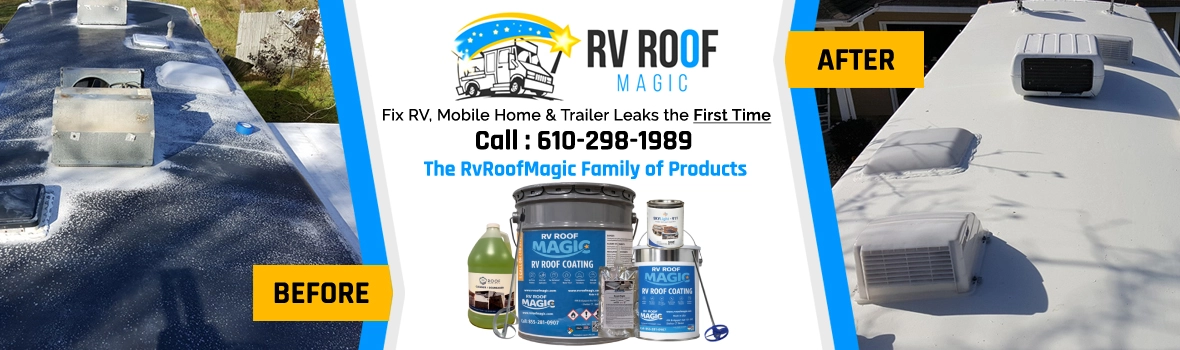
Why you should consider RV Roof Magic
Full disclosure: I was skeptical. Most roof coatings I’d used were a hassle—multiple coats, primers that took forever, and results that lasted maybe five years if I was lucky. Then I tried RV Roof Magic, and I’m not going back.
One Coat. No Primer.
This is the part that sold me. One coat application. No primer needed. You can literally finish your entire roof in a day and be ready for a storm tomorrow. No waiting days for cure time. No second-guessing if you applied enough.
Last fall, I coated my 32-footer on a Saturday morning. By Sunday afternoon, we got hit with an unexpected rainstorm. Not a single leak. My neighbor, who used a traditional two-coat system, was still waiting for his primer to cure while I was sipping coffee in my dry rig.
It Works on Almost Everything
Here’s where RV Roof Magic really shines—it’s the ONLY RV roof coating that plays nice with pretty much any surface. EPDM rubber? Check. TPO? Check. Fiberglass? Metal? Previously coated surfaces? Check, check, check.
No more standing in the store aisle wondering if you bought the right product. No more compatibility anxiety. If your RV roof isn’t PVC or coated in silicone, you’re good to go. (And honestly, if you’ve got silicone up there, you’ve got other problems.)
Pro tip: Do a quick vinyl-adhesion test if you’re unsure. And if your TPO roof’s scrim is showing, grab some TPO primer first. Otherwise, you’re golden.
It Lasts Longer Than any other roof sealants.
Traditional coatings? You’re lucky to get 4-5 years. RV Roof Magic? 18-20 years of protection. Let that sink in. You apply this stuff once, and you’re set for nearly two decades.
The company’s been doing this for 25+ years. They’ve got thousands of reviews from actual RV owners, not just lab tests. When a product survives that long in the real world, you know it’s legit.
How to Apply It:
Look, I’m not a professional contractor. I’m a guy who’d rather pay campsite fees than repair bills. If I can do this, you can too.
Step 1: Clean Like Your Roof’s Life Depends On It
Power wash if you can. Otherwise, scrub with mild detergent and rinse like crazy. Get every speck of dirt, grease, oil, and loose material off. I use a long-handled brush and spend a solid hour on this. It’s boring, but skipping it means the coating won’t stick.
Step 2: Check the Weather
You need temps above 50°F and no rain for 24 hours. I watch the forecast like a hawk and pick a clear weekend in early fall. Don’t try to rush this in November unless you’re in Arizona.
Step 3: Apply the Product
Use a roller with an extension handle. Work in sections, maintain a wet edge, and don’t skimp on thickness. The 1-gallon covers 50 sq ft, the 5-gallon covers 200 sq ft—don’t stretch it further, or you’re just cheating yourself.
Step 4: Wait
“Apply today, drive away tomorrow” is legit. It dries fast, but give it a full day before you test it with a rainstorm or snow. I usually wait 36 hours just to be safe.
Winter Habits That’ll Save Your Roof
Even with RV Roof Magic, a few smart habits go a long way:
Get snow off quickly: I use a soft brush or plastic rake. Metal tools are a no-no—they’ll scratch the coating. Don’t let heavy snow pile up for weeks.
Watch for ice dams: After those weird warm days in winter (you know the ones), check the edges of your roof. If ice is blocking drainage, carefully remove it.
Post-storm checks: After big storms, do a quick visual inspection. Falling branches happen.
Ventilate inside: Run your vent fans sometimes. Condensation under the membrane is real, and it’s gross.
Emergency Winter Leaks (The “Oh Crap” Moment)
Say you’re on a winter trip and find a leak. Maybe a branch fell, perhaps a seam gave way. RV Roof Magic can actually be applied in less-than-ideal conditions.
Clean the area as best you can—get the ice off, wipe it down, do what you can. Let it dry (a hairdryer helps in a pinch). Then apply RV Roof Magic right over the problem spot. Its adhesion is so strong that it’ll usually seal even when conditions aren’t ideal. I’ve patched a buddy’s roof in 40-degree weather, and it held until spring.
Bottom Line
Winter doesn’t have to mean worrying about leaks. A good inspection, some common-sense maintenance, and a quality coating like RV Roof Magic mean you can focus on enjoying those gorgeous winter campsites instead of checking your ceiling for water spots.
I’ve been running this stuff for three winters now. My roof looks brand new, I’ve had zero leaks, and I sleep like a baby when it’s pouring rain outside. The RV community online backs this up—thousands of reviews, 25+ years in business, and a product that actually does what it claims.
Don’t be the guy in the Walmart parking lot at dawn, desperately Googling “RV roof leak repair” while your ceiling drips. Be the smart RVer who handles it in October and spends winter actually enjoying their rig.
Check out rv roof magic and see what I’m talking about. Your future self, warm and dry inside while the snow falls outside, will thank you.
Trust me on this one. I’ve been there, done that, and learned the expensive way so you don’t have to.