
Let’s be honest: nobody buys an RV because they’re excited about roof maintenance. You bought it for the freedom, the views, and the open road. But here is the reality check – that thin layer above your head is the only thing standing between a great vacation and a $10,000 repair bill.
If you’ve spent any time in the RV community, you know that water is the ultimate enemy. Once it finds a way in, it doesn’t just sit there; it rots your frame, ruins your insulation, and creates mold. But here’s the good news: rv roof repair doesn’t have to be a nightmare. If you use the right materials and catch things early, you can actually outlast the factory life of your rig by nearly two decades.
The “4-Year Itch”: Why Standard Coatings Fail
Most people don’t realize that standard RV roof materials – whether it’s EPDM, TPO, or Fiberglass – are on a countdown timer. Traditional hardware store coatings usually give up the ghost after about 4 or 5 years. They dry out, they crack under the sun’s UV rays, and they can’t handle the constant “flexing” of a vehicle moving at 65 mph.
This is where a professional-grade rv roof coating changes the game. While the cheap stuff is failing, a high-quality application can give you an extra 18 to 20 years. That’s the difference between a quick weekend project and a total roof replacement down the road.
Don’t Wait for the Drip: The Two-Minute Inspection
You shouldn’t wait for a wet spot on your ceiling to check your roof. I always tell folks to get up there at least twice a year. You’re looking for the “Big Three” warning signs:
- The “Chalk” Factor: Run your hand across the roof. Does it come away white and powdery? That’s oxidation. Your roof is literally thinning out.
- The Smile Cracks: Look at the sealant around your AC unit and vents. If you see tiny cracks that look like little smiles, those are water highways.
- The Bubbles: Any lifting or bubbling means the bond is failing, likely due to trapped moisture or poor initial application.
The Secret to a Permanent Fix: Skip the Primer
One of the biggest headaches in RV roof repair is the multi-step process. Most brands force you to buy a cleaner, then a primer, then two or three coats of the actual product. It’s a waste of time and money.
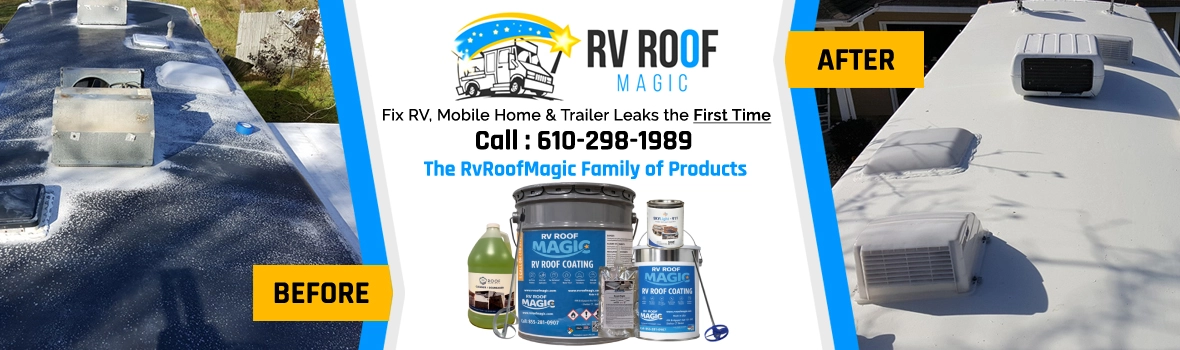
The reason so many DIYers and pros use RV Roof Magic is the “One Coat” chemistry. It’s built to be a standalone system. Whether you have an Alpha rubber roof, Aged Vinyl, Metal, or even a roof previously coated with Dicor or Kool Seal, this stuff bites into the surface and stays there.
Important Note: The only things this won’t play nice with are PVC roofs or existing silicone coatings. Silicone is like oil-nothing wants to stick to it. If you’ve got silicone up there, you’ll need to strip it first or look for an alternative; otherwise, the product will stay tacky.
Sealing the Vulnerable Spots
Before you roll on a full rv roof coating, you’ve got to handle the “hot spots.” These are your seams, screws, and transition lines.
Think of a high-quality rv roof sealant like Seam Tight or Butyl MS Caulk as your insurance policy. You apply these to the joints first. For really bad cracks, you can even embed Poly Fabric into the sealant. Once those are reinforced, the main coating is applied to create a single, seamless membrane. It’s like shrink-wrapping your entire RV in a waterproof shield.
Why Your “Moving Home” Needs Different Chemistry
A lot of people make the mistake of going to a big-box home improvement store and buying roof paint for a house. Do not do this. A house doesn’t move. A house doesn’t vibrate for six hours a day on the interstate. A house doesn’t experience “ponding water” in the same way an RV roof does when it’s parked slightly unlevel.
You need an ASTM-certified product. This isn’t just a fancy label; it means the product has been mechanically tested to handle the “stretch and pull” of a traveling vehicle. If your coating can’t handle a temperature swing from a freezing night in the mountains to a 100-degree day in the desert, it’s going to crack. Our unique chemical drying process ensures it stays flexible for years, not just months.
Step-By-Step: The Professional Way to Recoat
If you’re doing this yourself, don’t cut corners on the prep. Here is the workflow that gets the lowest fail rate:
- Deep Clean: Use something like Roof Protect Cleaner. You want all that dirt and old “chalk” gone. If the surface isn’t clean, the bond won’t be permanent.
- The Adhesion Check: If you aren’t sure what’s on your roof, do a small test patch. Better to find out now than after you’ve opened 5 gallons of product.
- Seal the Perimeters: Take your RV roof sealant and go around every vent, ladder mount, and skylight.
- The Clear View: While you’re up there, check your skylights. They usually turn yellow and brittle. A Clear coat like Skylight 911 can save them from shattering.
- The Big Roll: Apply your coating. The beauty here is that you can apply it in temperatures that would ruin other coatings. Once it’s down, you’re usually good to drive away by the next day.
The Bottom Line: Maintenance vs. Replacement
Look at it this way: a full roof replacement can easily run you $5,000 to $10,000, depending on the size of your rig. A few pails of premium RV roof coating and a Saturday afternoon of work cost a tiny fraction of that.
Plus, you get the peace of mind that comes with a 10-year warranty. We’ve seen thousands of customers – from houseboats to shipping containers to high-end motorhomes – save their roofs using this exact method.
Final Thoughts for the Road
Maintenance isn’t about being paranoid; it’s about being smart. Your RV is a huge investment, and the roof is its most important part. By using a one-coat, primer-free system, you’re not just fixing a leak-you’re upgrading your vehicle.
Don’t let a leaky roof ruin your next adventure. If you have questions about your specific roof type or how much product you need, check out the estimate calculator or the FAQ section over at rv roof magic.
Safe travels, and keep it shiny side up!